← Back to blogResearch
Why experts rank small-group tutoring so highly
Dr Indramohan Singh29 September 2026

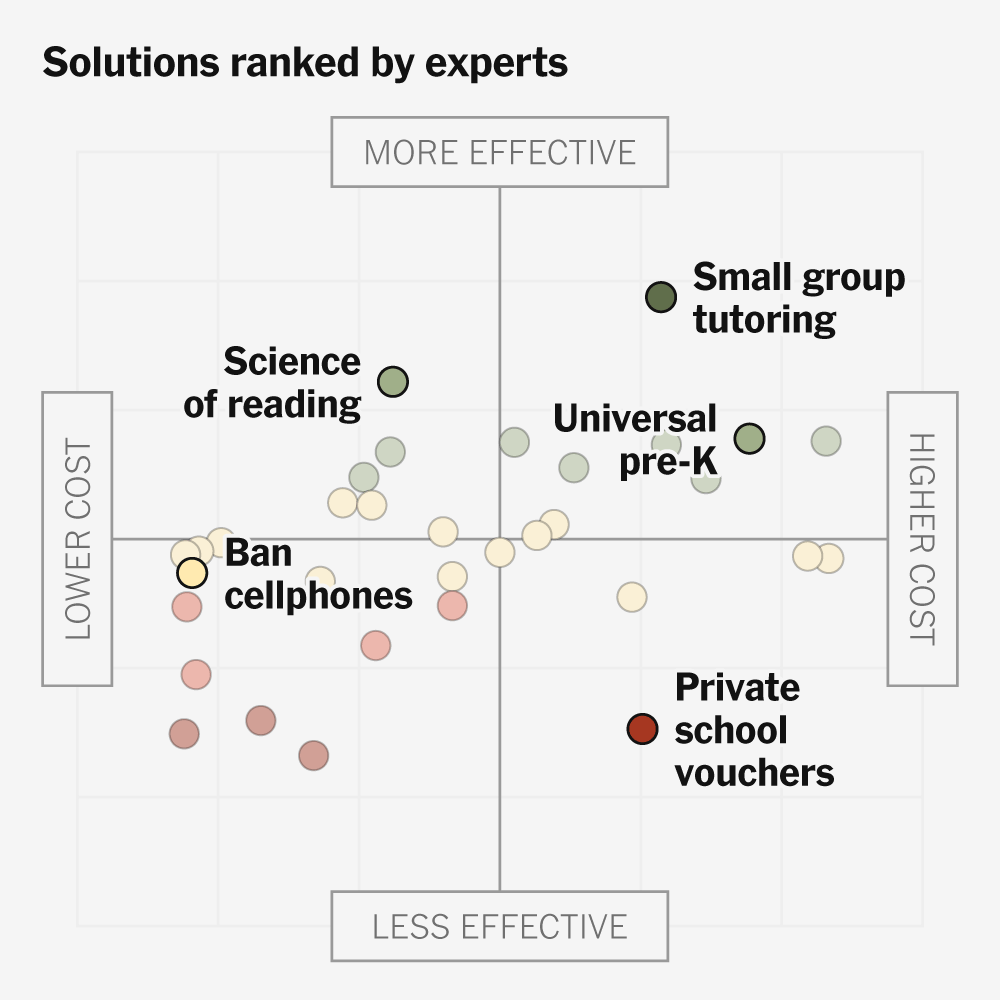
A chart ranking education solutions by effectiveness and cost makes one point immediately visible: small-group tutoring sits high on effectiveness, but also on cost. It is an arresting picture — and a useful starting point — but an expert ranking is not the same thing as a controlled study. The stronger question is whether the wider evidence supports the direction of that judgement.
Evidence for Learning defines small-group tuition as one educator working with two to five students. Its international Teaching and Learning Toolkit rates the approach as having moderate impact for low cost, based on moderate evidence. It also reports that support is most likely to work when it is targeted to a student's specific needs, with diagnostic assessment used to decide where teaching should begin.
That detail matters. A group of five is not automatically effective merely because it is small. The value comes from what the tutor can do within that group: notice misconceptions, question each student, adapt the explanation, connect tutoring to classroom learning and check whether understanding is secure before moving on.
Small groups can also create a learning opportunity that private instruction does not reproduce in quite the same way. Students hear different approaches, explain their reasoning and learn to make their thinking visible. The tutor still provides explicit guidance, but students are not passive recipients of an answer.
This is why EduPrism caps its live groups at five students and begins with a diagnostic. The 1:5 model is designed to preserve targeted attention while giving students a carefully matched group in which to reason, explain and practise. Progress is monitored over time; the format itself is never treated as a guarantee of a particular grade or score.
The Australian evidence deserves a careful qualification. Evidence for Learning's Australasian summary says local efficacy evidence is inconclusive because small-group tuition is often delivered alongside other interventions and few local studies isolate its effect. The studies reviewed nevertheless indicate potential benefits for learning and for communication and interpersonal skills.
So the chart should not be read as a promise that any tutoring labelled ‘small group’ will work. It is better read as a prompt for sharper questions: How many students are in the group? Is support based on diagnosed needs? Is the tutor trained and consistent? Are students expected to explain their thinking? Is progress checked? Those implementation choices are where an evidence-informed model becomes a meaningful learning experience.
Book a free assessment — a genuine diagnostic conversation about where your child is, and what comes next.
Book your diagnosticWe'll email you each new article when it's published. Unsubscribe any time.